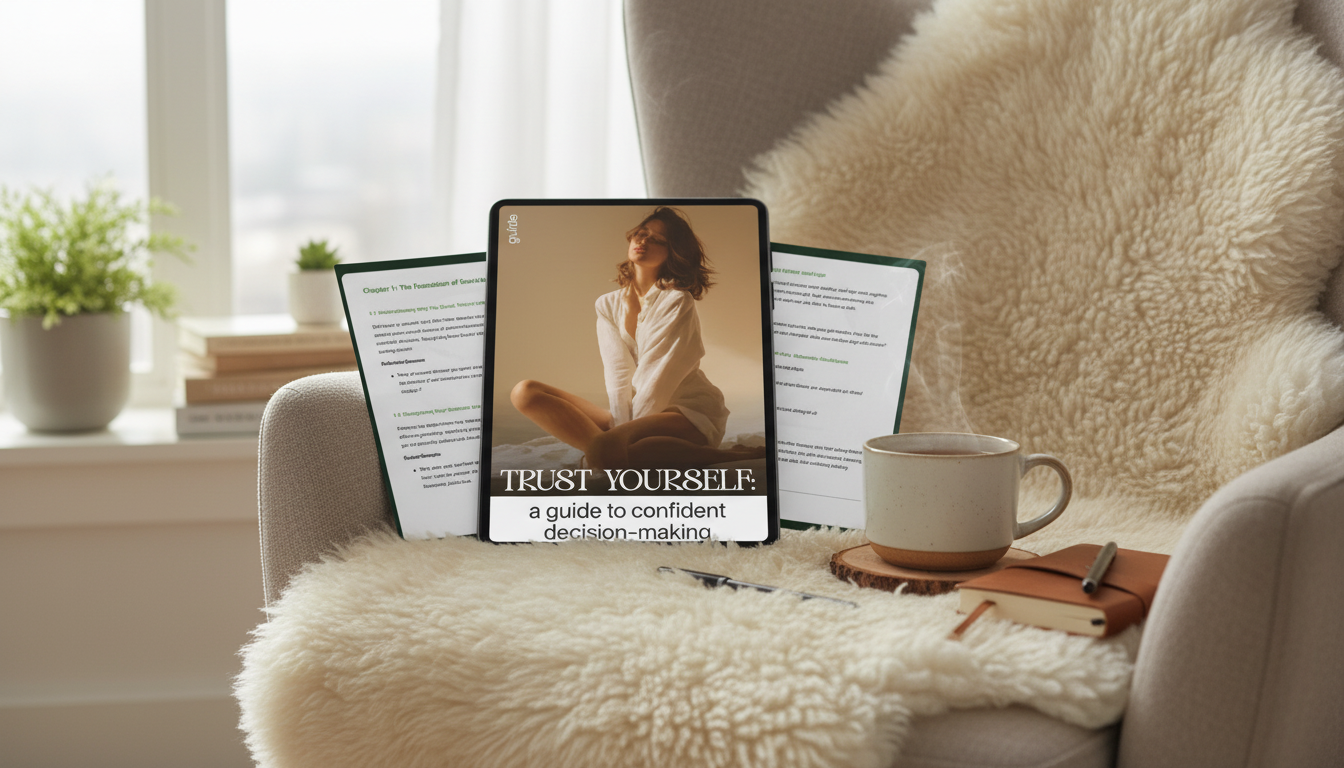
Confidence in decisions rarely comes from finding a “perfect” answer—it grows from learning how to listen to inner signals, test choices in small ways, and follow through with self-respect. Self-trust is a skill set: clarifying what matters, calming mental noise, choosing with enough information (not endless research), and building proof through consistent action. The goal isn’t to eliminate uncertainty; it’s to become someone who can move forward wisely even when certainty isn’t available.
Self-trust is the ability to make a choice, act on it, and adapt without self-attack. It’s not the absence of doubt—it’s doubt staying in the passenger seat while your values keep hands on the wheel. The mindset shift is subtle but powerful: replace “I must be certain” with “I can handle the outcome and learn fast.”
Self-trust tends to grow from three places. First, alignment: your decisions match your values. Second, evidence: you’ve followed through before, even in small ways. Third, regulation: your nervous system is calm enough to think clearly. (A related concept is self-efficacy—belief in your ability to perform behaviors needed for outcomes—defined in the APA Dictionary of Psychology.)
Many “I can’t decide” moments aren’t really about the decision. They’re about the pressure around it.
If stress is high, your system may be scanning for threat rather than fit. Practical self-help tools for stress and anxiety can support clearer thinking (see the NHS mental health self-help guidance).
Complicated decisions become manageable when they’re reduced to a repeatable sequence. Use this four-part framework when you feel stuck or scattered.
| Step | Prompt | Example output |
|---|---|---|
| Values | What matters most in this season? | Stability + growth |
| Options | What are 2–4 realistic choices? | Option A / B / C |
| Consequences | What’s the best, likely, and worst case? | Likely: manageable trade-offs |
| Small step | What action gives new data within 48 hours? | Schedule a 15-minute consult |
Inner guidance is easier to access when it’s separated from stress responses and outside noise.
To make this easier, a structured prompt set can help turn “I should” into a clear plan. The digital guide Trust Yourself: A Guide to Confident Decision-Making (PDF download) is designed for daily check-ins, decision templates, and quick reflection pages that build evidence over time.
| Situation | Best tool | Why it helps |
|---|---|---|
| Too many options | Minimum information rule | Stops endless comparison |
| Fear of regret | Regret minimization | Centers long-term priorities |
| High anxiety | Two-way vs one-way door | Restores perspective |
| No motivation | Micro-commitment | Creates momentum and evidence |
If building a calmer “decision space” helps, a small comfort cue can also support the routine—something that signals, “I’m safe enough to choose.” A desk or couch companion like the Cute Big-Eyes Meerkat Plush Toy – Soft Stuffed Animal Gift can serve as a gentle anchor during journaling or reflection. For everyday structure on the go, an organized carry option like the Tommy Hilfiger Men’s Black Handbag with Shoulder Strap can help keep essentials (notebook, printouts, planner) in one place—reducing friction when it’s time to follow through.
Define self-trust in behaviors—clear boundaries, honest choices, and follow-through—then practice one small promise daily. Review decisions for learning and adjustment rather than self-criticism.
Create evidence with micro-commitments, use simple decision rules to reduce noise, and treat many choices as reversible experiments. Track consistency over time, not perfection in a single moment.





Leave a comment