Grow Your Small Business With Free AI: Practical Ways to Improve Marketing, Operations, and Everyday Productivity
Free AI tools can remove busywork, speed up decision-making, and help small teams produce professional marketing and smoother operations—without hiring right away. The key is building simple, repeatable workflows you can use every week for customer messaging, content creation, admin tasks, and daily planning so growth comes from better systems, not longer hours.
What it means to grow your business (in real-world terms)
Growth isn’t only “more sales.” For many owners, real progress looks like better margins, more repeat customers, faster turnaround times, fewer mistakes, and less stress while serving the same (or more) clients.
- Growth can mean: higher revenue, improved profitability, better retention, or delivering the same results with fewer hours.
- Healthy growth balances: demand creation (marketing and sales) with delivery capacity (operations and support).
- AI supports growth by: improving quality and consistency while speeding up writing, summarizing, planning, and customer communication.
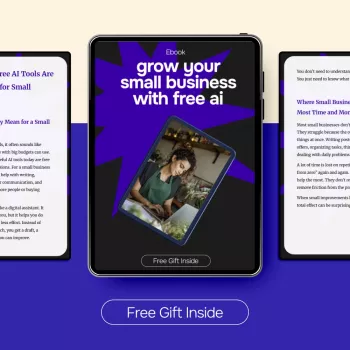
For practical guidance you can implement quickly, see Grow Your Small Business With Free AI – Practical eBook.
Why free AI tools are a practical advantage for small business owners
Free tools are useful because they let you test improvements before committing money or time to complex platforms.
- Low-risk experimentation: try new offers, emails, posts, and sales drafts quickly, then refine what performs.
- Faster iteration: generate multiple options for headlines, hooks, and outlines in minutes—then pick the best.
- Operational leverage: turn scattered notes and inbox threads into checklists, SOPs, and client-ready summaries.
- Better consistency: create reusable templates for brand voice, replies, and internal steps, so work doesn’t restart from scratch.
For general small-business operations guidance, the U.S. Small Business Administration (SBA) is a helpful reference point.
What the practical eBook helps you set up
Most owners don’t need complicated automation—they need a few reliable routines that reduce rework. A practical setup includes:
- A simple marketing workflow: define the offer, clarify the audience, and produce content that matches the customer’s stage (awareness, consideration, purchase).
- An operations workflow: intake forms, service checklists, follow-up sequences, and basic documentation to reduce mistakes.
- An everyday productivity workflow: daily planning, email triage, quick research summaries, and meeting note cleanup.
- Reusable templates: built for owners who want outcomes and clarity—without getting buried in technical complexity.
Marketing wins you can implement in a single afternoon
Marketing gets easier when you stop reinventing the message. Start with one “core offer description,” then repurpose it across channels.
- Offer clarity: draft a one-sentence promise, a short deliverables list, and three differentiators customers actually care about.
- Content batching: turn one offer description into 10 post ideas, 5 short emails, and 3 ad angles.
- Customer Q&A library: create answers to common objections, then reuse them as posts, scripts, and web copy.
- Local and niche targeting: produce location-specific variants and industry examples without rewriting from the ground up.
Operations upgrades that reduce friction and protect your time
Operations are where many small businesses “leak” profit: missed details, inconsistent onboarding, or slow follow-ups. Free AI tools can help you standardize what’s already working.
- Create SOPs from existing work: after completing a task once, capture the steps and turn them into a checklist.
- Client onboarding: build a consistent intake questionnaire and a welcome message that sets expectations.
- Follow-up automation (without sounding robotic): draft polite reminders, status updates, and next-step emails.
- Quality control: use AI-assisted checklists to catch missing details in orders, proposals, and deliverables.
For responsible AI usage considerations, review the NIST AI Risk Management Framework and the FTC’s guidance on truthful, fair AI practices: Federal Trade Commission.
Everyday productivity: small changes that compound
Daily productivity isn’t about doing more tasks—it’s about protecting focus and reducing “open loops.” A few lightweight routines can compound fast.
A 14-day rollout plan to start using AI without overwhelm
Two-week starter map: task, output, and payoff
| Day range |
Focus |
Deliverable |
How it helps |
| 1–3 |
Offer + audience |
One-page offer brief |
Speeds up content and sales conversations |
| 4–7 |
Marketing batch |
10 posts + 5 emails + FAQ set |
Creates consistent visibility without daily scrambling |
| 8–10 |
Operations |
One SOP + onboarding checklist |
Reduces mistakes and back-and-forth |
| 11–14 |
Productivity |
Daily plan + email templates + weekly review |
Protects deep work time and improves follow-through |
Common pitfalls to avoid when using free AI tools
Who this practical eBook is best for
Recommended resources in stock
Get the eBook and build a simple AI system you can reuse
FAQ
What does it mean to grow your business?
Growth can mean higher revenue, stronger margins, more repeat customers, or serving the same customers with less time and stress. Sustainable growth balances demand creation (marketing/sales) with delivery capacity (operations/support), and AI can reduce time costs by improving speed and consistency.
What is the easiest business to grow?
Businesses with repeat demand, clear offers, and scalable delivery tend to grow faster—think standardized products, subscriptions, or productized services. In practice, consistent marketing and reliable operations often matter more than picking the “perfect” niche.
Can free AI tools really help with marketing and operations?
Yes—free tools are especially useful for drafting, summarizing, planning, and turning scattered information into reusable templates. The key is to review output for accuracy, protect sensitive data, and build repeatable workflows instead of relying on one-off results.
Recommended for you







Leave a comment