
HomeBlogBlogTravel Journal Prompts: 5-Minute Entries & Weekly Review

Travel Journal Prompts: 5-Minute Entries & Weekly Review

Travel Journal Prompts: 5-Minute Entries & Weekly Review

A great travel journal turns fleeting moments into stories that can be revisited for years—without requiring perfect handwriting, long sessions, or “writer” confidence. With the right set of questions and mini-activities, a few minutes a day can capture the details that photos miss: sounds, scents, conversations, and the small surprises that make a trip feel alive.

What Makes a Travel Journal Worth Re-Reading

The entries that hold up over time usually do one thing well: they recreate the experience, not just the itinerary. Instead of listing what you did, aim to preserve what it felt like to be there.

  • Focus on sensory specifics: what you heard, smelled, tasted, and touched—not only what you saw.
  • Record decision points: why you chose a place, what changed your plans, and what you learned from detours.
  • Capture people and dialogue: a short quote, a mannerism, or a tiny interaction that defines a day.
  • Write micro-entries: 3–7 sentences, a quick list, or one vivid paragraph that fits real travel.
  • Balance facts with feelings: pair locations and times with emotional beats (calm, awe, frustration, joy).

Memory is reconstructive, meaning details can fade or shift over time—anchoring entries with sensory cues and context makes them easier to “re-enter” later. For a helpful overview of how memory works, see the APA Dictionary of Psychology: Memory.

Quick-Start Routine: A 5-Minute Entry That Works Anywhere

When energy is low or the day is packed, use a repeatable template. It prevents blank-page staring and still creates a rich record.

  1. Anchor line: add a timestamp and location (even approximate).
  2. Three-part core: (1) highlight, (2) challenge, (3) surprise.
  3. One “detail keeper”: a color, smell, texture, or overheard phrase.
  4. One-line takeaway: what to repeat, avoid, or notice tomorrow.
  5. Optional add-on: a tiny sketch map (hotel → café → viewpoint) to reconnect scenes later.

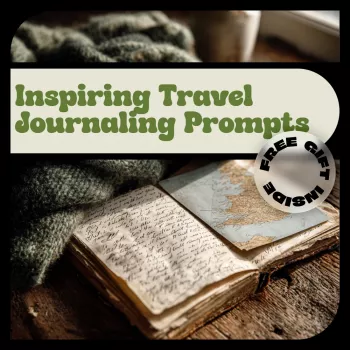
If you prefer structure you can reuse daily, the Inspiring Travel Journaling Prompts eBook (digital download) is built for quick entries on the move and deeper reflections on slower days.

Journaling Ideas for Different Moments of a Trip

Different moments call for different lenses. Rotate the focus so the trip doesn’t blur into one long list of activities.

  • Arrival: “What does this place sound like right now?” and “What did the first 10 minutes teach?”
  • Exploring: “What would be missed by someone rushing through?” and “What feels uniquely local today?”
  • Food: “Describe a dish using texture words only,” and “What did the meal reveal about the culture?”
  • People: “A small kindness witnessed,” and “A conversation that shifted perspective.”
  • Nature & streetscapes: “Find one repeating pattern (shapes, colors, materials) and describe it.”
  • Evening reflection: “What moment deserves a second look?” and “What would be a perfect caption—and why?”

Creative Formats When Words Feel Hard

Some days are too full (or too tiring) for paragraphs. Switching formats keeps journaling lightweight while still preserving meaning.

  • Lists: “10 tiny details,” “5 things learned,” “3 mistakes,” “1 unexpected joy.”
  • Postcard-style entry: write to your future self one year from now.
  • Two-column contrast: “Expectation vs. Reality,” “Tourist view vs. local rhythm.”
  • Sketch + labels: a doorway, transit ticket, or menu item—then label what stands out.
  • Found-language collage: collect words from signs/menus and build a short poem.
  • Photo companion notes: write what happened just outside the frame and what the camera couldn’t capture.

One practical tip: keep your journaling tools easy to grab. A compact crossbody can help you carry a notebook, pen, and essentials without digging through a larger bag—like the Tommy Hilfiger Men’s Black Handbag with Shoulder Strap.

Use Prompts to Preserve Meaning (Not Just Events)

The most powerful travel entries often connect the day to values, perspective, and personal patterns. Even a short reflection can deepen what you remember later.

  • Values check-in: “What mattered most today, and how was it shown?”
  • Perspective shift: “What assumption was challenged?”
  • Memory coding: “If this day were a soundtrack, what three songs fit and why?”
  • Place-based insight: “What does this destination do well that home could learn from?”
  • Gratitude with specificity: “One person/place/object that made today easier—and how.”

Many people find that short, reflective writing helps organize experiences and emotions. For an evidence-based overview, see Pennebaker: Expressive Writing (Overview of research).

A Simple Weekly Review to Turn Notes into a Keepsake

7-Day Travel Journal Check-In (Fill-in Template)

Day Best moment One detail to remember What changed plans One sentence takeaway
Day 1
Day 2
Day 3
Day 4
Day 5
Day 6
Day 7

Digital Download eBook: A Ready-to-Use Set of Travel Journaling Prompts

For a ready-to-use collection you can open on your phone or print at home, explore the Inspiring Travel Journaling Prompts | Travel Journal Prompts eBook | Digital Download Guide for Travelers, Creatives & Memory Keepers.

And if you like adding comfort to your travel routine—especially for long rides—a small travel buddy like the Cute Big-Eyes Meerkat Plush Toy – Soft Stuffed Animal Gift can pair nicely with a calm, end-of-day reflection ritual.

FAQ

How many prompts should be used per day while traveling?

Use 1–3 on most days, especially if you’re moving around a lot. Rotating categories (sensory, people, food, reflection) keeps entries fresh, and micro-entries are enough when time is tight.

What if journaling feels forced or repetitive on a long trip?

Switch formats—try lists, quick sketches, or “expectation vs. reality” columns—and save deeper writing for a weekly review. Focusing on one “detail keeper” per day also prevents burnout while keeping memories vivid.

Do travel journaling prompts work for scrapbooks and photo albums?

Yes—use them as captions, page titles, or short story blocks that add context beyond the photos. Pair one prompt with 1–3 images and a brief note describing any small artifact (ticket, receipt, label) to strengthen the memory.

Was this article helpful?

Yes No
Leave a comment
Top

Yay! 10% Off Just for You!

Join our community and enjoy 10% off your first order. Subscribe for exclusive deals!

Shopping cart

×